Which Period of Japanese Art Is Known for Reflecting the Warring Interests of the Shogunate?
Influence of Buddhism in the Heian Period
The Heian period in Japan witnessed a flowering of art and architecture influenced by Esoteric and Pure Land Buddhism.
Learning Objectives
Describe the Amida hall and images of the Amida Buddha portrayed in the art of Pure Land Buddhism
Fundamental Takeaways
Key Points
- The Heian Menses (794 – 1185 CE) is considered Japan'south "Golden Age," a loftier point in Japanese civilization that greatly influenced art and architecture.
- Early Heian period sculptures inherited and modified late Nara period sculptural forms while developing new depictions of Esoteric Buddhist deities . During this fourth dimension, woods also replaced statuary as the most common material for making Buddhist sculptures.
- The primal role of ritual in Japanese Esoteric Buddhism led to a flourishing of the religious arts in the Heian catamenia. Religious paintings, mandalas , and statues provided practitioners with ways to contemplate Buddhist deities and concepts.
- Pure Land Buddhism, offering conservancy through belief in the Buddha of the Western Paradise, also influenced Japanese fine art.
- The Kyoto dignity created a new form of Buddha hall, known every bit the Amida hall, which blends the secular with the religious and houses one or more Buddha images inside a structure resembling the mansions of the nobility.
- The golden Amida sculpture inside the famous Phoenix Hall was executed by the influential sculptor Jōchō, who used a new catechism of proportions and the new sculptural technique of yosegi.
- Yamato-due east , considered the classical Japanese style , was showtime developed during the late Heian period and inspired by the Tang Dynasty Chinese "blue and green style" of mural painting.
Key Terms
- yamato-east: A classical Japanese style of painting, commencement developed during the late Heian catamenia and inspired by Tang Dynasty paintings.
- Esoteric Buddhism: A complex and multifaceted system of Buddhist idea and do that evolved over several centuries.
- Raigō: An appearance of the Amida Buddha on a purple deject at the time of one's death, which gave rise to a type of Japanese painting (a raigō-zu) of a Buddha accompanied by bodhisattvas.
- mandala: Any ritualistic geometric design symbolic of the universe used equally an aid to meditation, particularly in Hinduism and Buddhism.
- Saichō: (767 – 822) A Japanese Buddhist monk credited with founding the Tendai schoolhouse of Buddhism based on the Chinese Tiantai school he was exposed to during his trip to Tang China beginning in 804.
- Kūkai: (774–835) A Japanese monk, civil servant, scholar, poet, and artist; founder of the Shingon or "True Word" school of Buddhism.
- Fujiwara: A powerful family of regents in Japan that originated when the founder, Nakatomi no Kamatari (614-669), was rewarded past Emperor Tenji with the honorific name.
Background: The Heian Period
In 784, the Japanese Emperor Kammu, threatened by the growing secular power of the Buddhist institutions in the city of Nara, moved the capital of Japan to Heian-kyō (Kyōto), which remained the regal majuscule for the next 1,000 years. The Heian Period, as information technology came to be chosen, refers to the years between 794 and 1185 when the Kamakura shogunate was established at the end of the Genpei War. It is considered Japan's "Aureate Age," a high point in Japanese civilisation that later generations have always admired. The period is as well noted for the ascension of the samurai class, which would eventually take ability and start the feudal menses of Japan.
Influence of Esoteric Buddhism
The Tardily Nara period saw the introduction of Esoteric Buddhism to Japan from Mainland china by Kūkai and Saichō, who founded the Shingon and Tendai schools. The Heian menstruation witnessed a flowering of Buddhist art and architecture and the introduction of Esoteric Buddhism to Japan. Early on Heian period sculptures inherited and modified tardily Nara period sculptural forms while developing new images to depict wrathful Esoteric deities. During this time, wood also replaced bronze as the nigh mutual cloth for making Buddhist sculptures.
Kūkai impressed the emperors who succeeded Emperor Kammu and generations of Japanese, non only with his religious practices only also with his poetry, calligraphy , painting, and sculpture. Shingon Buddhist practice is based on diverse rituals, including the chanting of mantras , hand gestures (mudras), and meditation through visualization of mandalas. The central role of these rituals in Japanese Esoteric Buddhism led to a flourishing of the religious arts in the Heian period. Religious paintings, mandalas, and statues provided practitioners with ways to contemplate Buddhist deities and concepts.
A famous example of a Shingon mandala is the Taizokai (Womb World) mandala. Part of the Mandala of the Two Realms, the Womb World is composed of 12 zones representing dissimilar dimensions of Buddha nature. In the center sits the Vairocana Buddha within the lotus of compassion, surrounded by attendant Buddhas and Bodhisattvas . The Shingon sect believed that all beings have an innate Buddha nature.

Taizokai (Womb Earth) Mandala (Second Half of the Ninth Century): The center square represents the young phase of Vairocana Buddha (hanging ringlet, color on silk).
Pure Country Buddhism and the Fujiwara Regency
Pure Country Buddhism offers salvation through belief in Amida Buddha (the Buddha of the Western Paradise). This branch of Buddhism became pop in Nihon during the Fujiwara regency (794–1185), named for the powerful clan that dominated Japanese politics in the middle Heian period. The Fujiwara family, then the most powerful in the country, ruled equally regents for the Emperor, effectively condign hereditary ceremonious dictators. Formal trade with China concluded, allowing for the development of ethnic cultural forms. The Fujiwara period was a time of cultural and artistic flowering at the purple court and amidst the aristocracy, and the Kyoto dignity developed a society devoted to elegant artful pursuits.
The Amida Hall
New types of images were adult to satisfy the devotional needs of the increasingly important Pure Country sects in the 10th century. They created a new course of Buddha hall known as the Amida hall, which blends the secular with the religious and houses one or more than Buddha images within a structure resembling the mansions of the nobility. The Hō-ō-dō (Phoenix Hall, completed in 1053) of the Byōdō-in, a temple in Uji to the southeast of Kyoto, is ane of the finest examples of Fujiwara Amida halls. It consists of a master rectangular structure flanked by two 50-shaped wing corridors and a tail corridor, ready at the edge of a large bogus pond. Inside, a single golden image of Amida (c. 1053) is installed on a high platform.
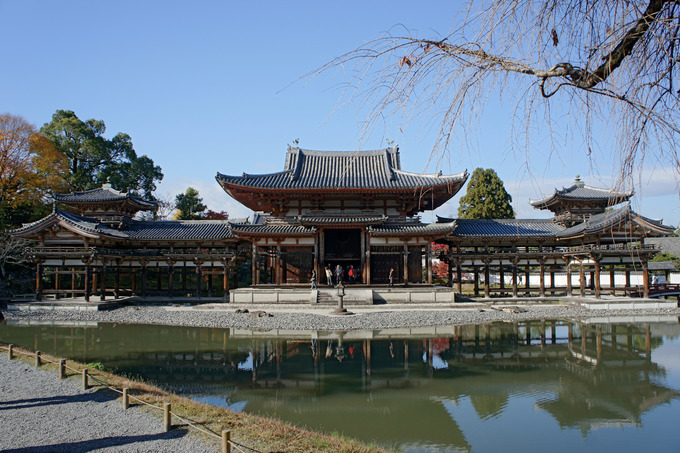
Byōdō-in Phoenix Hall, Uji, Kyoto: The Phoenix Hall of the Byōdō-in is an exampla of Fujiwara Amida halls.
Raigō
Other popular images include the Raigō, which depicts the appearance of the Amida Buddha on a floating cloud along with his attendant celestial Bodhisattvas, Kannon and Seishi, at the time of i's death. A fine example of this type of epitome is found in the Phoenix Hall, whose walls are decorated with small relief carvings. These works describe the host believed to have accompanied Amida when he descended from his celestial realm to gather the souls of believers at the moment of decease and transport them in lotus blossoms to the Western Paradise.

Amida Raigo painting: Color on silk, tardily Heian period. The Raigo image was introduced in Japan by the Pure Land Schoolhouse of Fine art during the Fujiwara Regency.
A famous early case of Raigō imagery dating from 1053 is painted on the interior of the Phoenix Hall doors of the Hō-ō-dō. It depicts the descent of the Amida Buddha and is 1 of the first examples of Yamato-e, a classical style of Japanese painting inspired by Tang dynasty paintings and fully developed by the belatedly Heian period. It contains landscape elements such every bit softly rolling hills that seem to reflect the bodily advent of the scenery effectually Kyoto. Stylistically, the painting is securely influenced past the Tang Dynasty Chinese "blue and dark-green style" of landscape painting traditions.
Amida Sculpture
A growing sense of grace, refinement, and softness emerged in Amida-style Buddhist sculptures, which culminated in the work of Jōchō (d. 1057), a Japanese sculptor of the Heian period. Jōchō's workshop in Kyoto perfected the Wayō or "Japanese style" of sculpture. He used a new canon of proportions forth with a new technique, yosegi, in which a single paradigm is carved from multiple pieces of forest joined from the inside. While this technique limited the amount of surface particular an artist could cleave into each piece, it forced the sculptor to convey his intended bulletin within these preset limits. This resulted in effectively and more ephemeral pieces. Most importantly, it allowed several assistants to work on the sculpture at once, greatly speeding upward the procedure. Jōchō'due south sculptures were remarkable for their intricately carved halos and the kindness and compassion of their elegant facial expressions.
Painting and Calligraphy in the Heian Period
In the Heian period, a style of calligraphy and painting emerged that was unique to Japan.
Learning Objectives
Evaluate the reasons for the emergence of a uniquely Japanese style of calligraphy during the Heian period
Fundamental Takeaways
Key Points
- Soukou Shujitsu is regarded as the outset text with a unique manner of Japanese calligraphy .
- In the last century of the Heian period, the horizontal, illustrated narrative handscroll known equally emaki came to the fore.
- Dating from most 1130, the Genji Monogatari Emaki, a famous illustrated Tale of Genji, represents the earliest surviving yamato-e handscroll and is considered one of the high points of Japanese painting.
- 12th-century emaki artists devised a organization of pictorial conventions that convey the emotional content of each scene. In the 2d half of the century, a livelier style of continuous narrative illustration became popular.
- The key role of ritual in Japanese Esoteric Buddhism led to a flourishing of religious painting and mandalas , which provided practitioners ways to contemplate Buddhist deities and concepts. A famous example is the Taizokai (Womb World) mandala.
Central Terms
- mandala: Any ritualistic geometric pattern symbolic of the universe, used as an aid to meditation, peculiarly in Hinduism and Buddhism.
- kana syllabary: Syllabic Japanese scripts, a part of the Japanese writing system, that contrast with the logographic Chinese characters known in Japan as kanji (漢).
- yamato-e: A manner of Japanese painting inspired by Tang dynasty paintings and fully developed by the late Heian period; information technology is considered the classical Japanese manner.
- hanging coil: 1 of the many traditional ways to brandish and showroom Chinese painting and calligraphy, in which the work is displayed for short periods of fourth dimension and then rolled up and secured for storage.
- handscroll: A traditional Asian roll of papyrus, parchment, or paper that has been written, fatigued or painted upon, which unfolds horizontally then that the reader can view one section at a time while holding it.
Calligraphy in the Heian Period
In the Heian catamenia, a manner of calligraphy emerged that was unique to Japan. Writing had been popularized, and the kana syllabary was devised to deal with elements of pronunciation that could not be written with the borrowed Chinese characters. At the time, Japanese calligraphers withal fitted the basic characters, chosen kanji (漢), into the squares laid out centuries before.
Soukou Shujitsu is regarded every bit the starting time text that shows a fashion unique to Japanese calligraphy. The Tanka (短) poem below was written in 749 CE and shows some differences from Chinese calligraphy. The authentically Japanese wayō (和) manner, or wayō-shodō (和), is attributed to Ono no Michikaze (894-966 CE), one of the so-called sanseki (三, "3 Brush Traces"), along with Fujiwara no Sukemasa and Fujiwara no Yukinari. The "Cry for noble Saichō ", a poem written by Emperor Saga on the occasion of Saichō's death, was 1 of the examples of this transformation. Ono no Michikaze served as an archetype for the Shōren-in schoolhouse, which later became the Oie mode of calligraphy. The Oie way was used for official documents in the Edo catamenia and was the prevailing style taught in terakoya schools of that fourth dimension.

Soukou Shujitsu: Soukou Shujitsu is regarded equally the first text that shows a manner unique to Japanese calligraphy. This Tanka (短) poem was written in 749 CE and shows some differences from Chinese calligraphy.
Emaki
In the last century of the Heian catamenia, the horizontal, illustrated narrative handscroll known as emaki came to the fore. Dating from well-nigh 1130, the Genji Monogatari Emaki, a famous illustrated Tale of Genji, represents the earliest surviving yamato-e handscroll and is considered ane of the high points of Japanese painting. Written about the year thou by Murasaki Shikibu, a lady-in-waiting to the Empress Akiko, the novel deals with the life and loves of Genji and the world of the Heian court after his death. The 12th-century artists of the emaki devised a organisation of pictorial conventions that convey the emotional content of each scene.
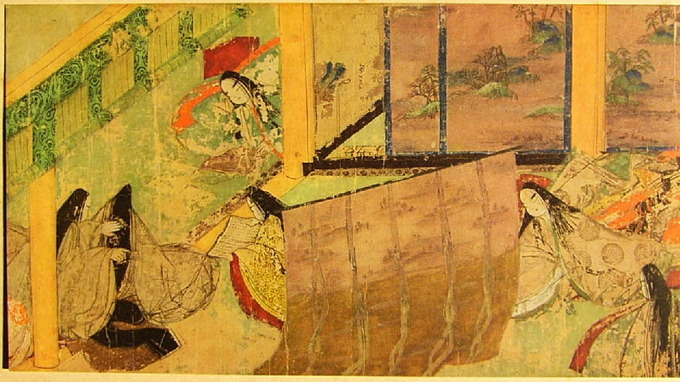
Panel from the Genji Monogatari Emaki Pictorial Scroll: A scene from the Illustrated coil of the Tale of Genji (written by Murasaki Shikibu in the 11th century). The multi-console drape at the centre bottom of the image is a kichō. The decorated sliding door panels at the pinnacle of the prototype are fusuma. The roll was fabricated in about 1130 CE and is in the Tokugawa Museum in Nagoya, Nippon.
In the second half of the century, a livelier style of continuous narrative illustration became popular. The Ban Dainagon Ekotoba (late 12th century), a scroll that deals with an intrigue at court, emphasizes figures in active movement depicted in rapidly executed brush strokes and sparse only vibrant colors.
Emaki also serve as some of the earliest and greatest examples of the otoko-e ("men'due south pictures") and onna-e ("women'due south pictures") styles of painting. There are many fine differences in the two styles, appealing to the perceived aesthetic preferences of the genders. Perhaps well-nigh easily noticeable are the differences in subject matter. Onna-due east, epitomized by the Tale of Genji handscroll, typically deals with court life, especially the court ladies, and with romantic themes. Otoko-e, on the other hand, often recorded historical events, specially battles. The Siege of the Sanjō Palace (1160), depicted in the "Night Set on on the Sanjō Palace" section of the Heiji Monogatari handscroll, is a famous example of this style.
Mandalas
The central function of ritual in Japanese Esoteric Buddhism led to a flourishing of religious painting and mandalas in the Heian period. These works provided practitioners with means to contemplate Buddhist deities and concepts. A famous case of a mandala from the Shingon school of Buddhism is the Taizokai (Womb Earth) mandala. Part of the Mandala of the Ii Realms, the Womb World is equanimous of 12 zones representing different dimensions of Buddha nature. The Shingon sect believed that all beings take an innate Buddha nature. In the center sits the Vairocana Buddha within the lotus of compassion, surrounded by attendant Buddhas and Bodhisattvas .

Taizokai (Womb Earth) Mandala (2d One-half of the Ninth Century): The center square represents the young phase of Vairocana Buddha. (hanging scroll, color on silk)
Source: https://courses.lumenlearning.com/boundless-arthistory/chapter/the-heian-period/
0 Response to "Which Period of Japanese Art Is Known for Reflecting the Warring Interests of the Shogunate?"
Post a Comment