Born Again Christian Not Good People

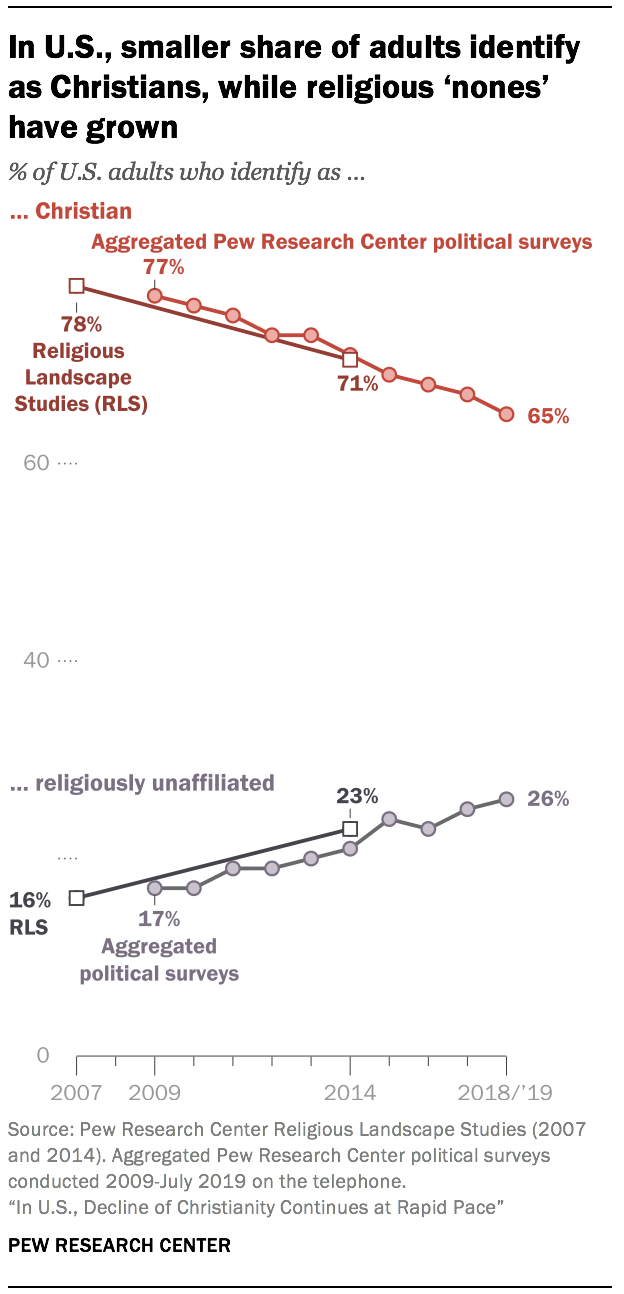 The religious landscape of the United states of america continues to alter at a rapid clip. In Pew Research Heart telephone surveys conducted in 2018 and 2019, 65% of American adults describe themselves as Christians when asked about their religion, down 12 percentage points over the past decade. Meanwhile, the religiously unaffiliated share of the population, consisting of people who describe their religious identity as atheist, doubter or "cypher in particular," now stands at 26%, up from 17% in 2009.
Both Protestantism and Catholicism are experiencing losses of population share. Currently, 43% of U.S. adults identify with Protestantism, downwardly from 51% in 2009. And ane-in-five adults (xx%) are Catholic, downward from 23% in 2009. Meanwhile, all subsets of the religiously unaffiliated population – a group also known as religious "nones" – have seen their numbers swell. Self-described atheists now account for 4% of U.S. adults, upwardly modestly only significantly from 2% in 2009; agnostics brand upwards 5% of U.S. adults, upward from 3% a decade ago; and 17% of Americans now draw their religion as "nothing in detail," upwardly from 12% in 2009. Members of not-Christian religions also take grown modestly as a share of the adult population.
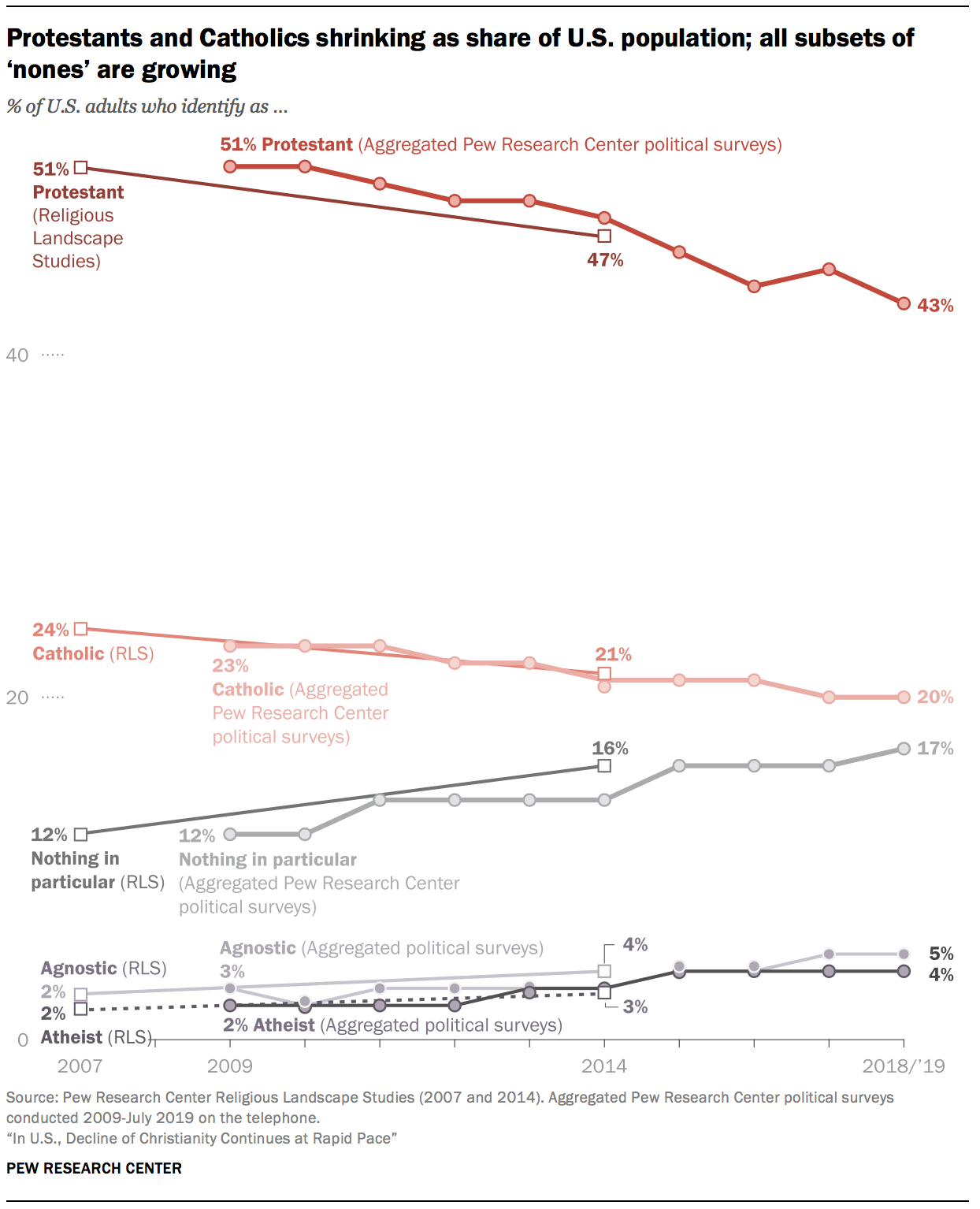
These are amongst the cardinal findings of a new analysis of trends in the religious composition and churchgoing habits of the American public, based on recent Pew Research Center random-digit-punch (RDD) political polling on the telephone.one The data shows that the trend toward religious disaffiliation documented in the Center's 2007 and 2014 Religious Landscape Studies, and before that in major national studies like the General Social Survey (GSS), has connected rapidly.
Pew Research Center'southward 2007 and 2014 Religious Landscape Studies were huge national RDD surveys, each of which included interviews with more than than 35,000 respondents who were asked dozens of detailed questions virtually their religious identities, beliefs and practices. The Center has non nevertheless conducted a third such study, and when the Mural Report is repeated, information technology is likely to use new methods that may prevent it from existence straight comparable to the previous studies; growing challenges to conducting national surveys by telephone have led the Eye to rely increasingly on self-administered surveys conducted online.two
But while no new Religious Mural Study is available or in the firsthand offing, the Center has collected 5 additional years of data (since the 2014 Landscape Study) from RDD political polls (come across detailed tables). The samples from these political polls are not as big equally the Landscape Studies (even when all of the political polls conducted in a year are combined), merely together, 88 surveys from 2009 to 2019 included interviews with 168,890 Americans.
These surveys do not include nearly as many questions nigh faith as the Mural Studies exercise. However, every bit part of the demographic battery of questions that ask respondents nigh their age, race, educational attainment and other background characteristics, each of these political polls too include i bones question near religious identity – "What is your present faith, if any? Are you Protestant, Roman Catholic, Mormon, Orthodox such every bit Greek or Russian Orthodox, Jewish, Muslim, Buddhist, Hindu, atheist, doubter, something else, or goose egg in detail?"
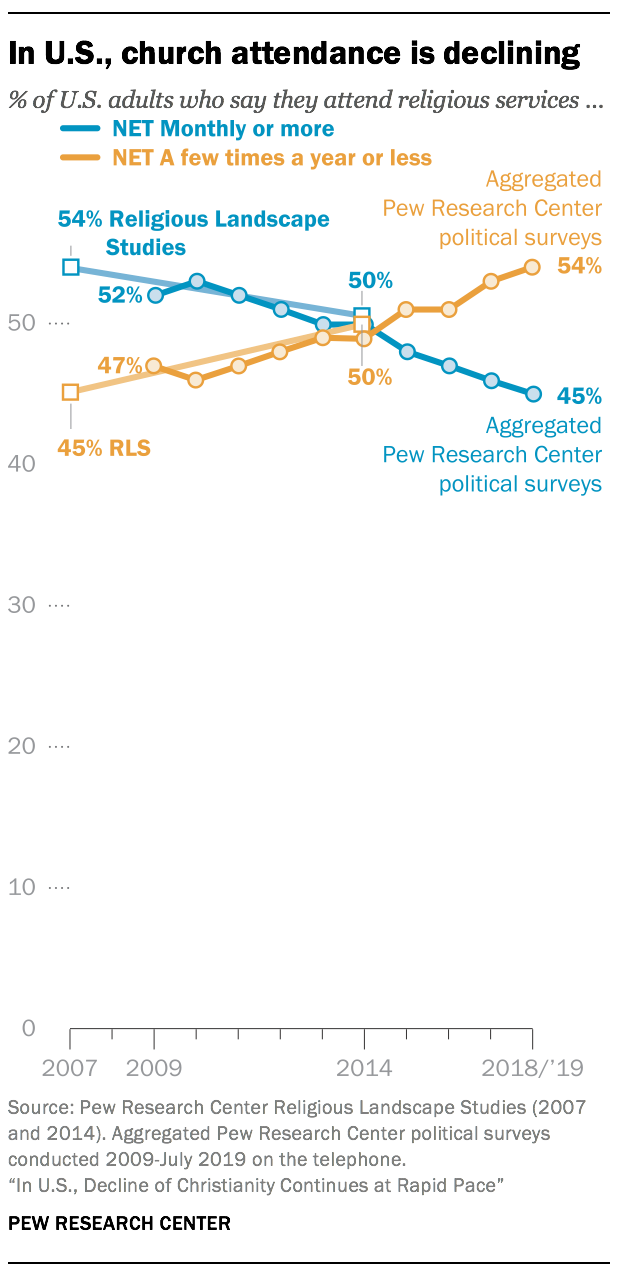 Additionally, most of these political polls include a question nearly religious attendance – "Aside from weddings and funerals, how often practice you attend religious services? More than than once a week, one time a week, one time or twice a month, a few times a year, seldom, or never?" Taken together, these two questions (one most religious identity, the other about religious attendance) tin can help shed light on religious trends in the U.S.
The data shows that just like rates of religious affiliation, rates of religious attendance are failing.3 Over the final decade, the share of Americans who say they attend religious services at to the lowest degree once or twice a month dropped by 7 pct points, while the share who say they nourish religious services less frequently (if at all) has risen past the same caste. In 2009, regular worship attenders (those who nourish religious services at least once or twice a month) outnumbered those who attend services only occasionally or not at all by a 52%-to-47% margin. Today those figures are reversed; more Americans now say they attend religious services a few times a year or less (54%) than say they nourish at to the lowest degree monthly (45%).
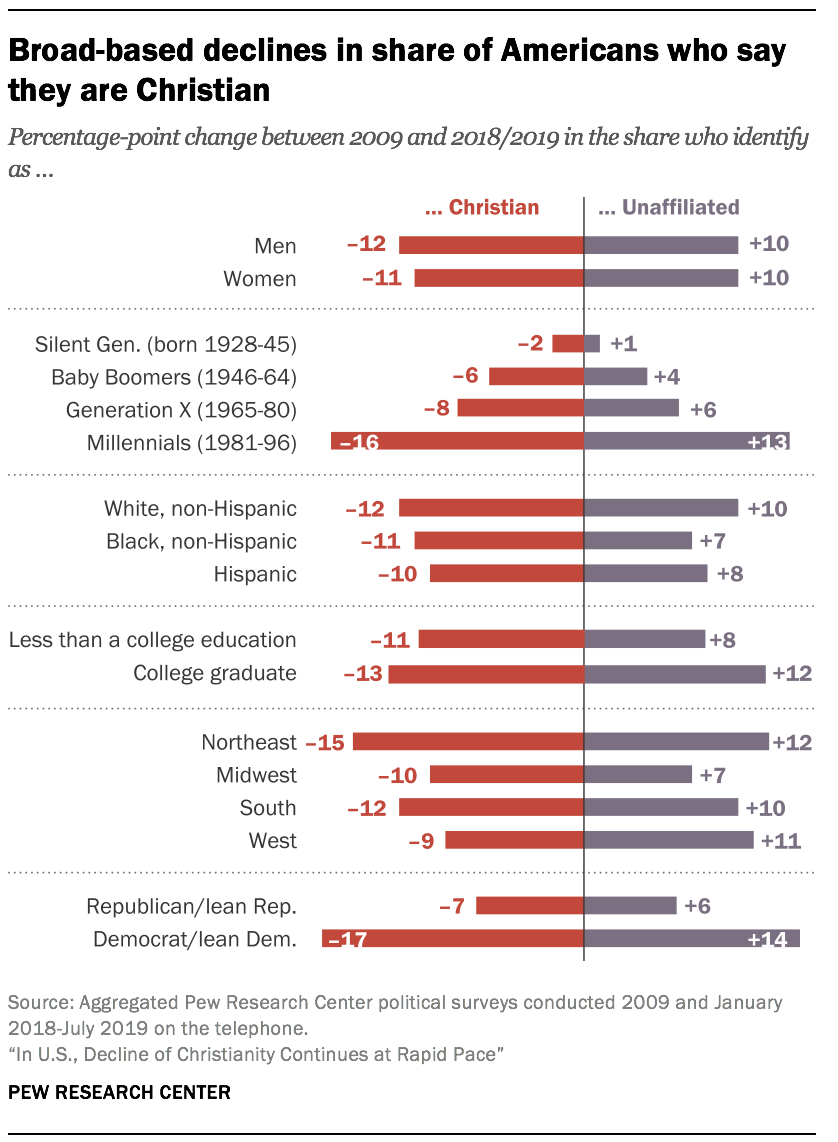 The changes underway in the American religious landscape are broad-based. The Christian share of the population is down and religious "nones" have grown across multiple demographic groups: white people, black people and Hispanics; men and women; in all regions of the country; and among higher graduates and those with lower levels of educational attainment. Religious "nones" are growing faster among Democrats than Republicans, though their ranks are swelling in both partisan coalitions. And although the religiously unaffiliated are on the rise among younger people and most groups of older adults, their growth is most pronounced among young adults.
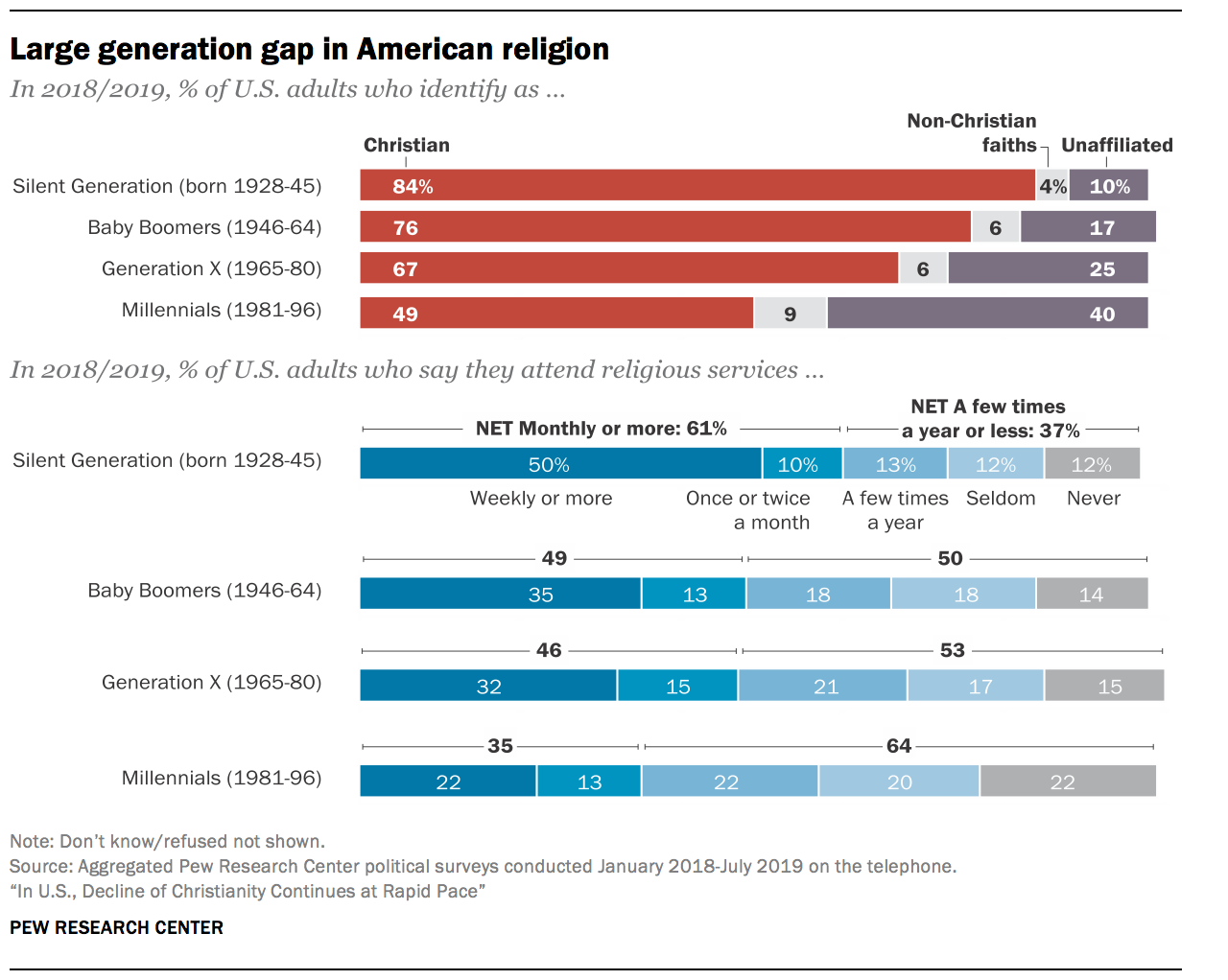
Furthermore, the information shows a wide gap between older Americans (Baby Boomers and members of the Silent Generation) and Millennials in their levels of religious affiliation and attendance. More than eight-in-ten members of the Silent Generation (those born between 1928 and 1945) describe themselves as Christians (84%), as do three-quarters of Baby Boomers (76%). In stark contrast, only half of Millennials (49%) describe themselves as Christians; iv-in-ten are religious "nones," and 1-in-10 Millennials identify with non-Christian faiths.
Only about ane-in-3 Millennials say they attend religious services at least in one case or twice a month. Roughly 2-thirds of Millennials (64%) attend worship services a few times a year or less ofttimes, including about four-in-ten who say they seldom or never go. Indeed, there are every bit many Millennials who say they "never" nourish religious services (22%) as there are who say they go at to the lowest degree once a calendar week (22%).
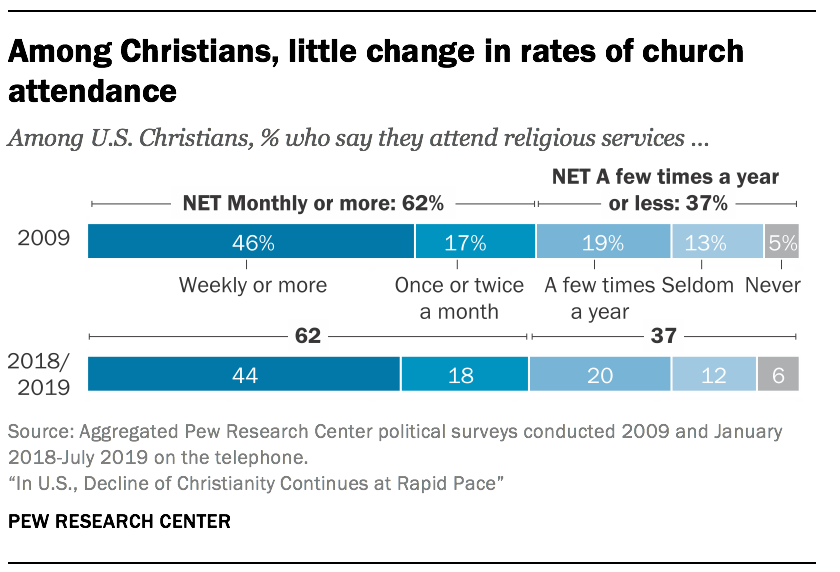 While the trends are articulate – the U.S. is steadily becoming less Christian and less religiously observant as the share of adults who are not religious grows – self-described Christians report that they attend religious services at almost the same rate today every bit in 2009. Today, 62% of Christians say they nourish religious services at least once or twice a month, which is identical to the share who said the same in 2009. In other words, the nation's overall rate of religious attendance is failing not because Christians are attending church building less ofttimes, but rather considering there are at present fewer Christians as a share of the population.
Other key takeaways from the new analysis include:
-
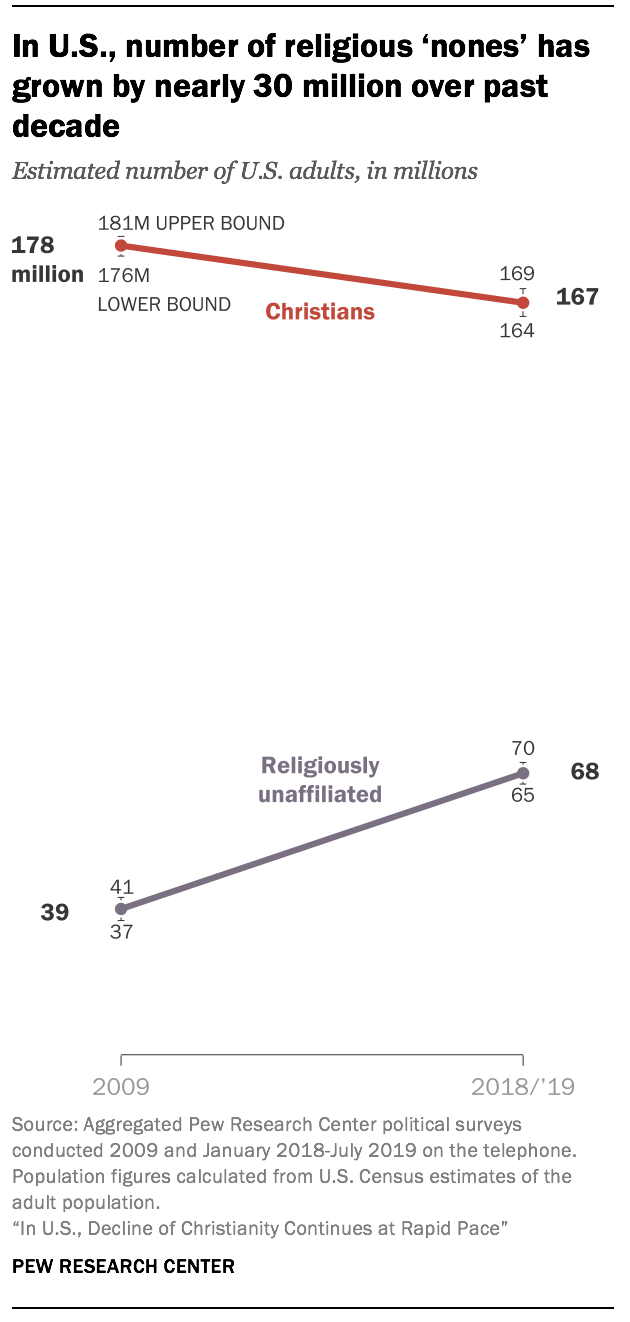 The data suggests that Christians are declining non merely as a share of the U.S. adult population, only also in absolute numbers. In 2009, there were approximately 233 one thousand thousand adults in the U.S., according to the Demography Bureau. Pew Research Center's RDD surveys conducted at the time indicated that 77% of them were Christian, which means that by this measure, at that place were approximately 178 1000000 Christian adults in the U.S. in 2009. Taking the margin of error of the surveys into account, the number of adult Christians in the U.S. every bit of 2009 could have been as low as 176 one thousand thousand or as high every bit 181 1000000.
Today, there are roughly 23 million more adults in the U.S. than there were in 2009 (256 million as of July 1, 2019, according to the Census Bureau). About two-thirds of them (65%) place every bit Christians, according to 2018 and 2019 Pew Inquiry Eye RDD estimates. This means that in that location are now roughly 167 million Christian adults in the U.S. (with a lower leap of 164 1000000 and an upper bound of 169 million, given the survey'southward margin of mistake).
Meanwhile, the number of religiously unaffiliated adults in the U.S. grew by almost xxx meg over this period.
-
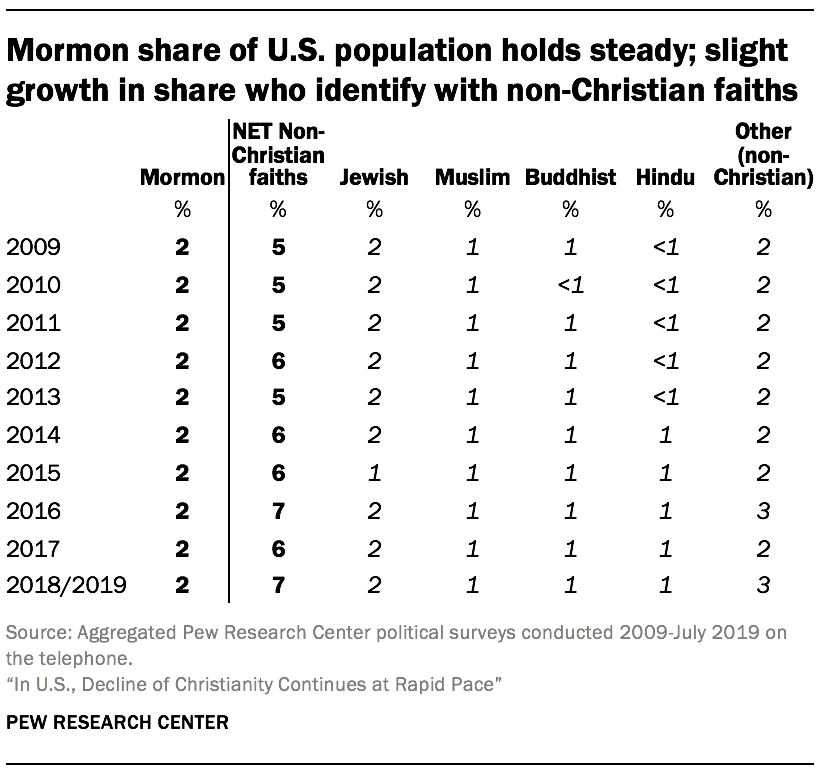 The share of Americans who depict themselves as Mormons has held steady at ii% over the past decade.4 Meanwhile, the share of U.S. adults who identify with non-Christian faiths has ticked up slightly, from 5% in 2009 to seven% today. This includes a steady 2% of Americans who are Jewish, along with ane% who are Muslim, one% who are Buddhist, i% who are Hindu, and 3% who identify with other faiths (including, for instance, people who say they bide by their own personal religious beliefs and people who describe themselves as "spiritual")five
 -
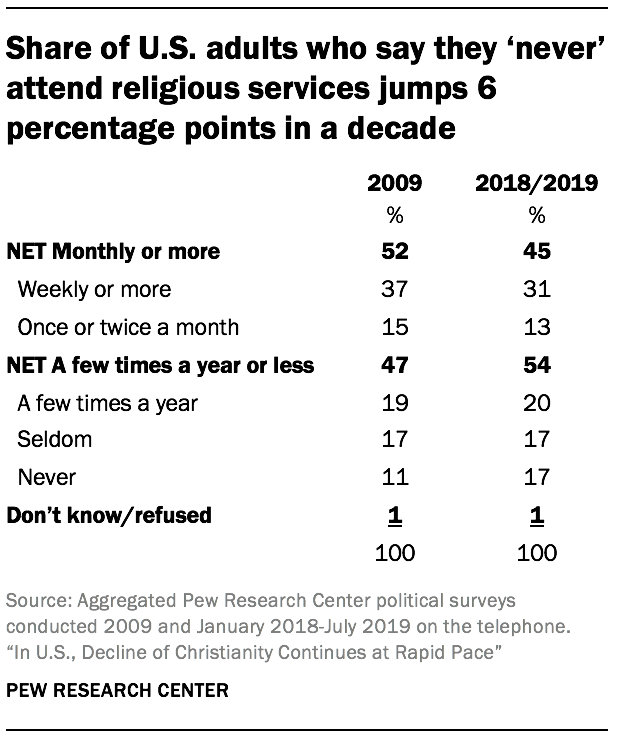 The ascent share of Americans who say they attend religious services no more than a few times a year (if at all) has been driven past a substantial leap in the proportion who say they "never" go to church. Today, 17% of Americans say they never nourish religious services, up from 11% a decade agone. Similarly, the decline in regular churchgoing is attributable mainly to the shrinking share of Americans who say they attend religious services at least once a calendar week, which was 37% in 2009 and now stands at 31%.
 -
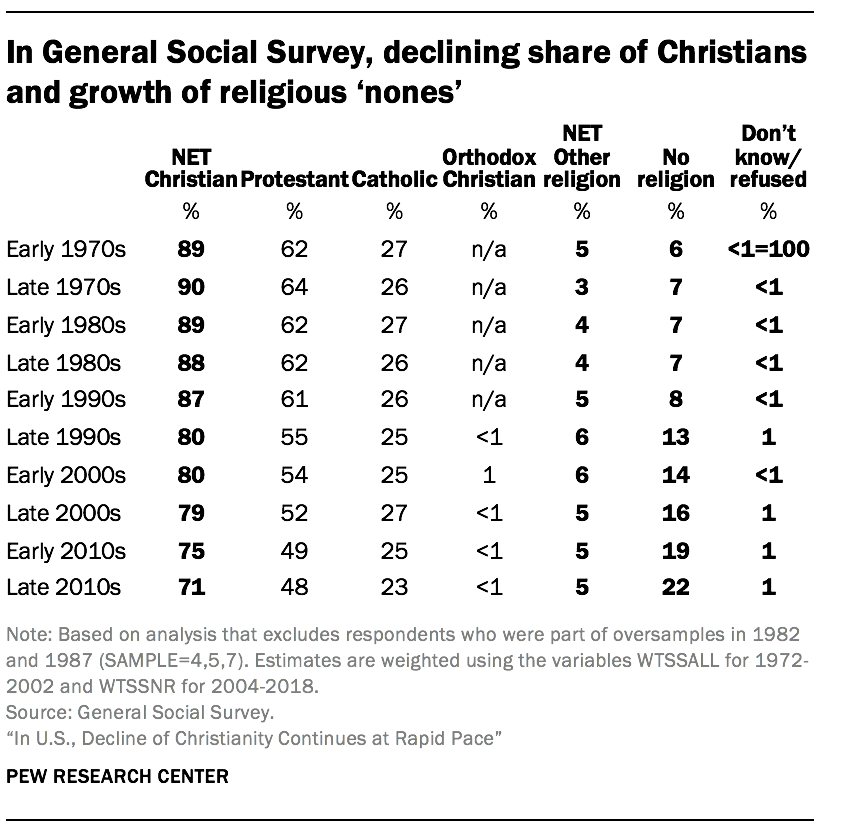 The trends documented in Pew Research Centre surveys closely resemble those found in the long-running General Social Survey (GSS), a project of the contained inquiry organization NORC at the Academy of Chicago, with main funding from the National Science Foundation. In GSS surveys conducted in the early 2000s (2000 to 2004), 80% of U.S. adults identified as Christians, including 54% who described themselves as Protestants and 25% who were Cosmic. Past the late 2010s, 71% of GSS respondents described themselves every bit Christians (48% Protestant, 23% Catholic). Over the same period, the GSS found that religious "nones" grew from 14% of the U.S. adult population to 22%.
The bespeak estimates from the GSS and Pew Research Heart surveys (that is, the share of adults who identify as Protestant or Catholic or as religious "nones") are non directly comparable; the two studies ask unlike questions and employ different modes of survey administration. But the fact that the direction of the tendency is similar in both studies strongly suggests that both are picking up on existent and significant change underway in the U.Due south. religious landscape.
These findings nearly the religious limerick of Hispanics closely resemble those from Pew Research Center'due south National Surveys of Latinos (NSL) – a nationally representative survey of U.S. Latino adults fielded almost every year. (Run into the detailed tables for complete trends in the religious composition of Hispanics based on both Pew Inquiry Heart political surveys and the NSL.)
-
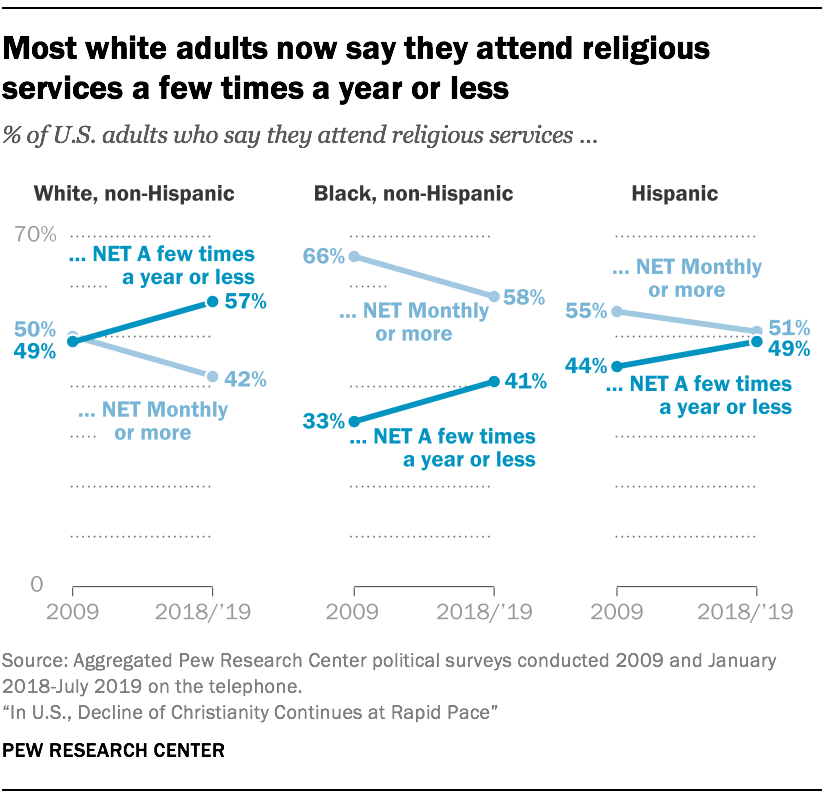 Among white adults, the share of people who say they nourish religious services a few times a year or less now exceeds the share who attend monthly or more (57% vs. 42%); a decade ago, the white population was evenly divided between those who went to church at least monthly and those who did not. Regular churchgoers still outnumber those who infrequently or never go to religious services among black Americans (58% vs. 41%), though the share of people who say they attend religious services a few times a year or less ofttimes has risen over the last decade amid black Americans, simply as it has amongst the population every bit a whole. U.Southward. Hispanics are now about evenly divided betwixt those who say they attend religious services at least one time or twice a calendar month (51%) and those who say they attend a few times a yr or less (49%).
 -
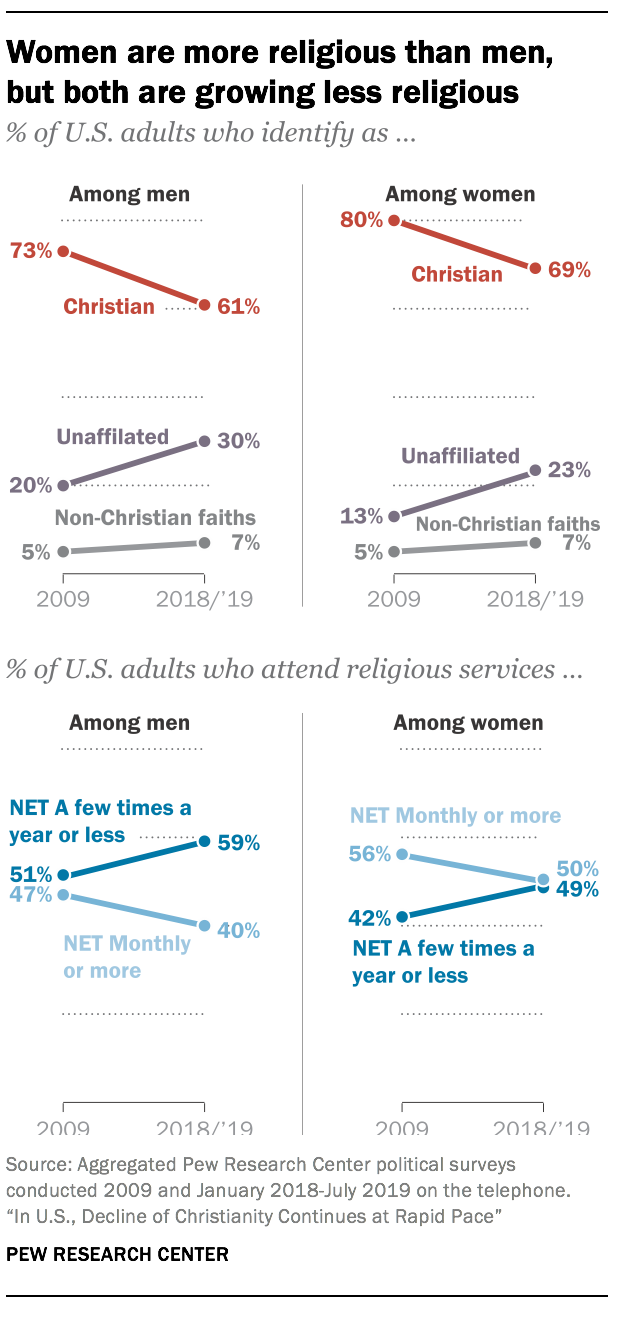 There is still a gender gap in American organized religion. Women are less likely than men to draw themselves equally religious "nones" (23% vs. 30%), and more likely than men to say they nourish religious services at least once or twice a month (fifty% vs. 40%). But women, like men, have grown noticeably less religious over the last decade. The share of "nones" among women has risen past 10 percent points since 2009 – like to the increment among men. And the share of women who identify as Christian has fallen by 11 points (from 80% to 69%) over that aforementioned catamenia.
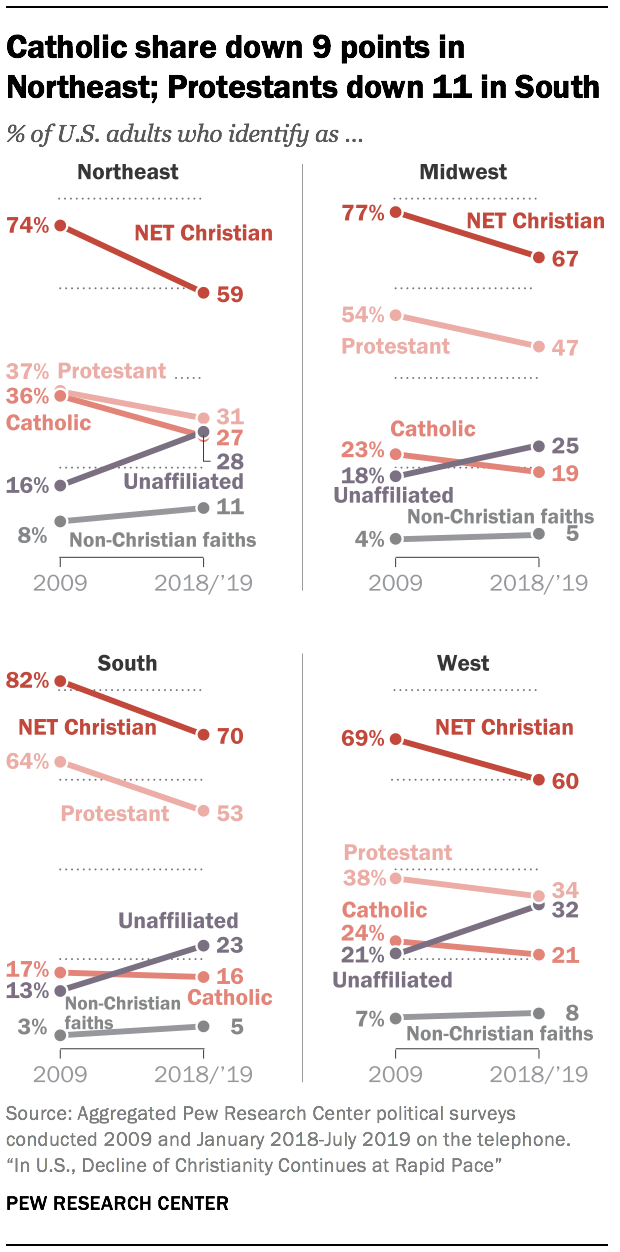
 - Christians accept declined and "nones" accept grown every bit a share of the adult population in all four major U.S. regions. Catholic losses accept been almost pronounced in the Northeast, where 36% identified as Catholic in 2009, compared with 27% today. Among Protestants, declines were larger in the South, where Protestants now account for 53% of the adult population, down from 64% in 2009.
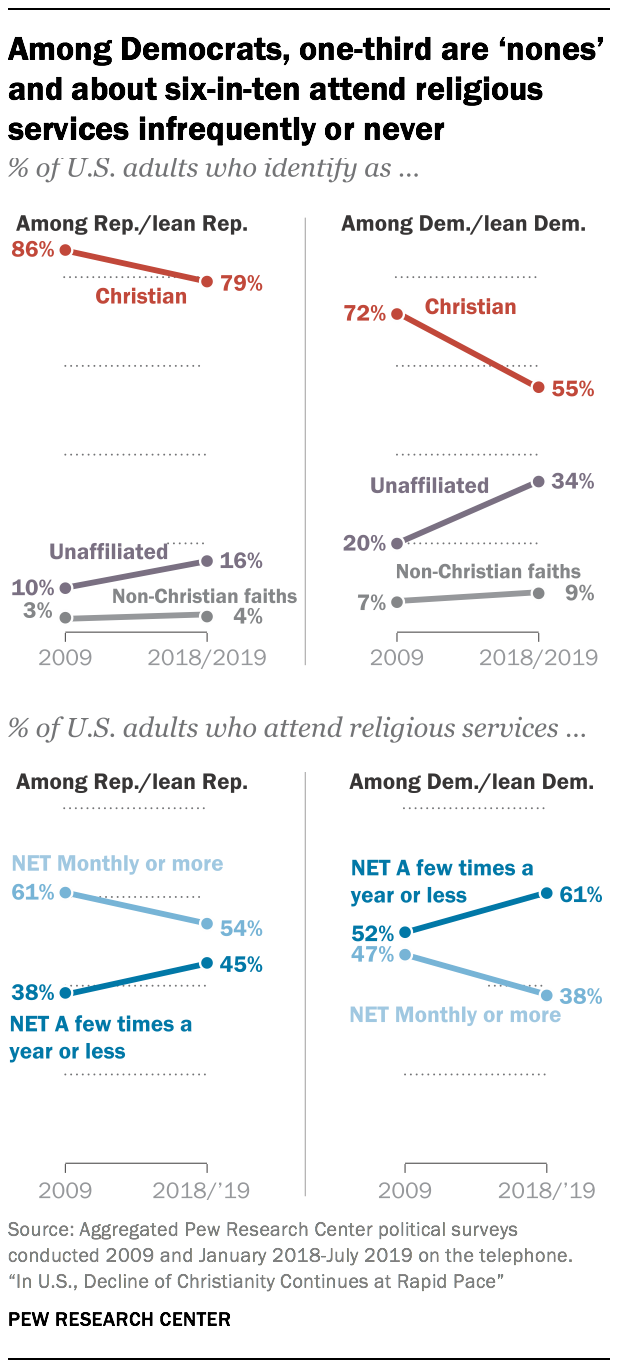
- Religious "nones" now make up fully ane-3rd of Democrats. And about six-in-ten people who place with or lean toward the Democratic Party say they nourish religious services no more than a few times a twelvemonth. The ranks of religious "nones" and infrequent churchgoers likewise are growing within the Republican Party, though they brand upwards smaller shares of Republicans than Democrats.
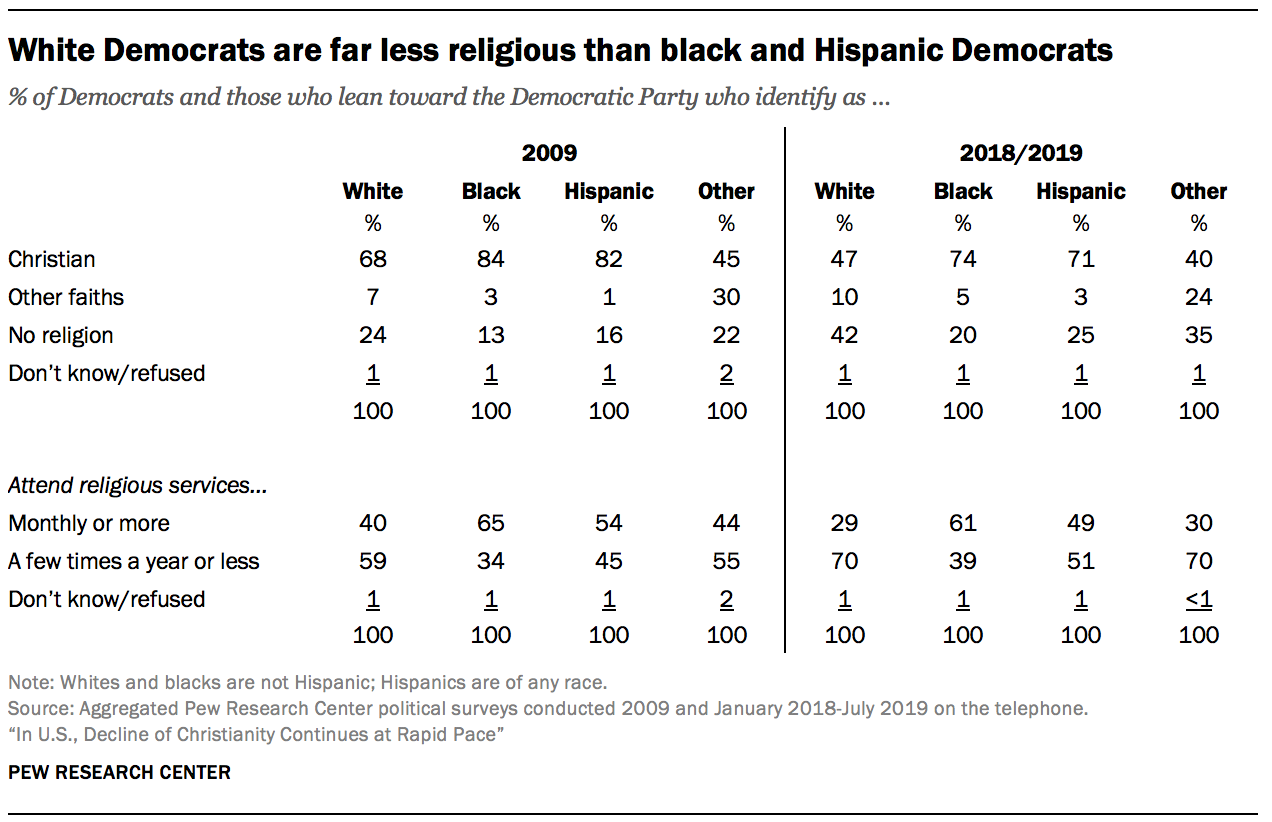
- The religious profile of white Democrats is very different from the religious profile of racial and ethnic minorities within the Democratic Party. Today, fewer than half of white Democrats draw themselves as Christians, and just 3-in-ten say they regularly attend religious services. More 4-in-ten white Democrats are religious "nones," and fully 7-in-ten white Democrats say they attend religious services no more than than a few times a yr. Black and Hispanic Democrats are far more likely than white Democrats to describe themselves as Christians and to say they attend religious services regularly, though all three groups are becoming less Christian.
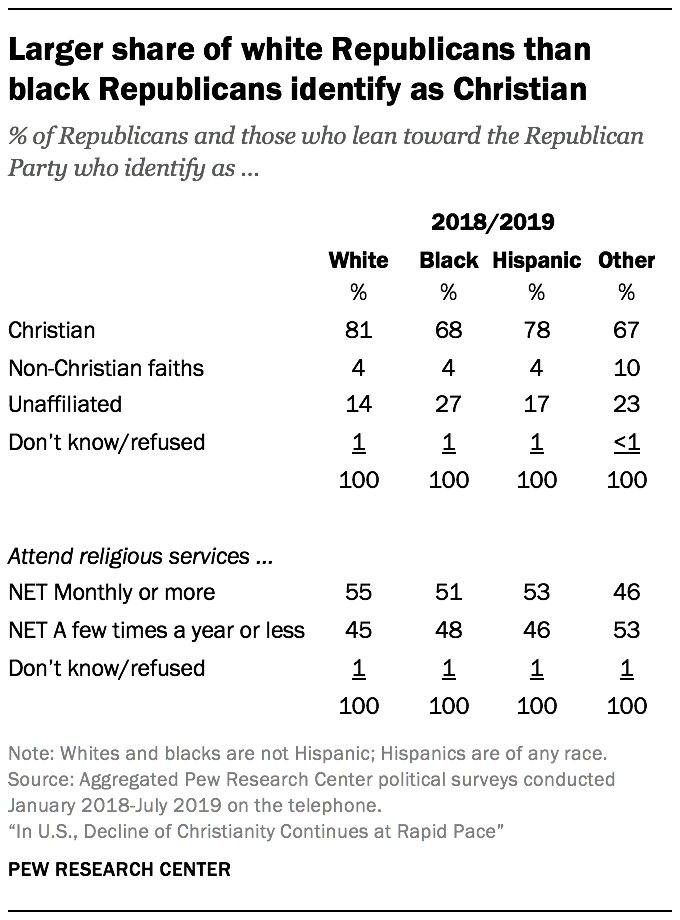 Although 2009 surveys did not include enough black Republicans to clarify separately, the most recent surveys testify smaller religious differences past race and ethnicity amid Republicans than Democrats.
 -
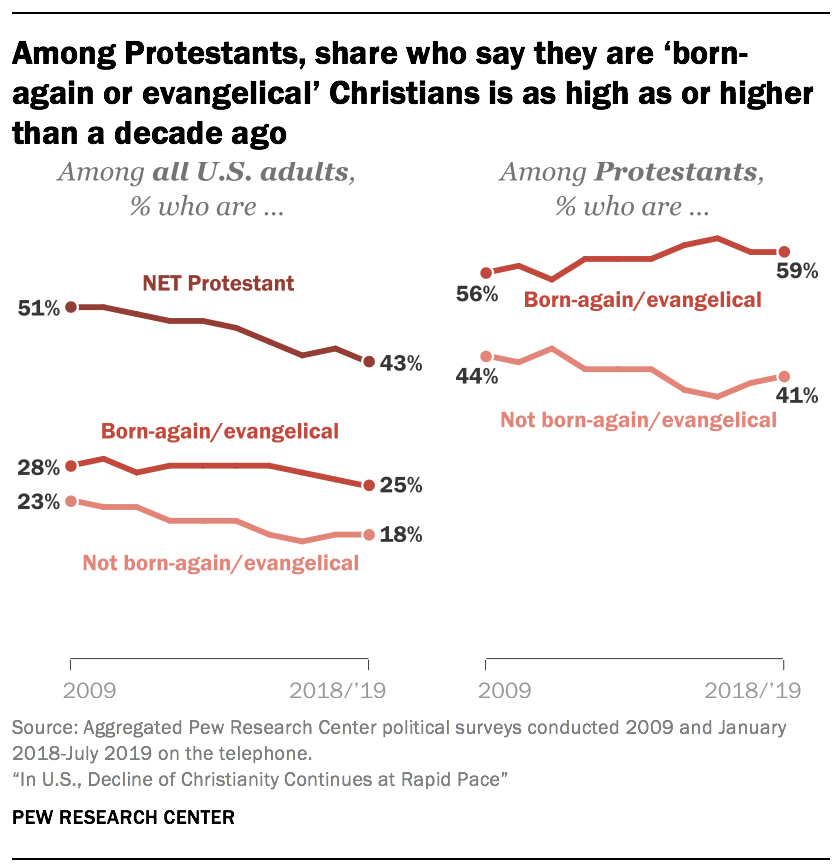 Pew Research Center'due south phone political polls do not typically include the detailed questions that are needed to determine whether Protestants identify with denominations in the evangelical, mainline or historically blackness Protestant tradition. Still, the political polls upon which this assay is based practice ask Protestants whether they think of themselves as "born-over again or evangelical" Christians. The data shows that both Protestants who draw themselves as born-again or evangelical Christians and Protestants who are non born-again or evangelical have declined as a share of the overall U.Southward. developed population, reflecting the country'southward broader shift away from Christianity as a whole. However, looking just at Americans who place every bit Protestants – rather than at the public as a whole – the share of all Protestants who are built-in-once more or evangelical is at least as high today as it was in 2009.
 -
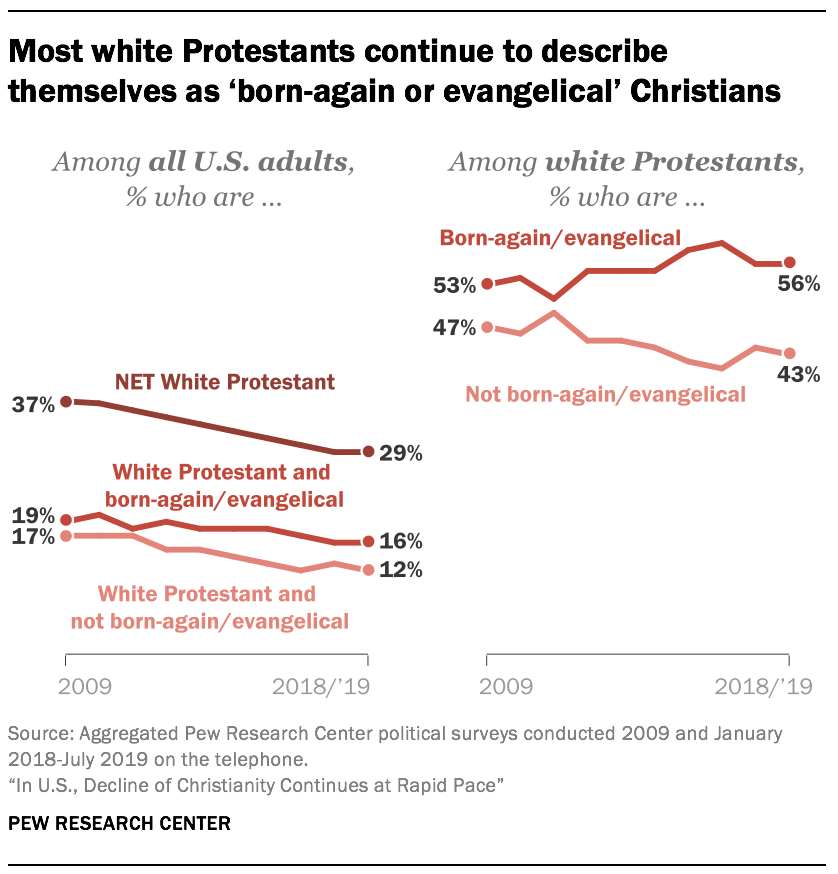 The share of U.S. adults who are white born-again or evangelical Protestants now stands at 16%, down from xix% a decade agone. The shrinking white evangelical share of the population reflects both demographic changes that have occurred in the U.s. (where white people constitute a declining share of the population) and broader religious changes in American society (where the share of all adults who identify with Christianity has declined). However, looking only at white Protestants – rather than at the public as a whole – the share of white Protestants who draw themselves as born-once again or evangelical Christians is at least as high as it was a decade agone.
For complete information about trends in the religious composition and worship attendance habits of the U.S. public, see detailed tables.
Source: https://www.pewresearch.org/religion/2019/10/17/in-u-s-decline-of-christianity-continues-at-rapid-pace/
0 Response to "Born Again Christian Not Good People"
Post a Comment